Most AI tool decisions in product and design teams are made on vibes and justified later. A slick demo on social media, a promised productivity leap, or simple FOMO is often all it takes for a new tool to land in an organization's workflow. Many of these tools solve problems teams never knew they had, while introducing friction, hidden time costs, and output that fails to meet human quality standards.
To help product teams navigate the noise, we are hosting an exclusive live session inside our Human in the Loop online community with Caleb Sponheim, AI Lead at Nielsen Norman Group.

Join the Live Event Inside Our Community
Want to evaluate your team's AI tech stack against real-world criteria? Join our free live session, participate in the open discussion, and bring your current AI tools to the test: Register for the Event in the Human in the Loop Community!

Why "Looks Good in a Demo" Isn't a Strategy
As organizations accelerate their adoption of artificial intelligence, product leaders and practitioners face a new operational challenge: evaluating whether a generative AI tool actually adds value or merely shifts the burden of work.
A tool might generate UI layouts, write copy, or synthesize research in seconds, but if reviewing and correcting that output takes twice as long as doing the work manually, the tool is a net negative for the workflow.
Evaluating AI tools requires moving past superficial capabilities and asking critical questions about:
- Workflow Alignment: Does the tool genuinely integrate into daily operations, or does it demand a context switch?
- Quality & Reliability: Does the output hold up against rigorous professional human standards?
- True Efficiency: What is the hidden cost in time, oversight, and cognitive load?

Introducing the PROVE Framework
To solve this dilemma, Caleb Sponheim developed the PROVE Framework at Nielsen Norman Group. Designed specifically for UX, design, and product professionals, the framework offers a structured, evidence-based methodology to determine whether an AI tool deserves a spot in your tech stack — or if saying "no" is the smarter strategic choice.
During this 60-minute community session, Caleb will walk through the core components of the framework, demonstrating how to assess AI tools systematically before committing team resources or enterprise budgets.
Following a short, high-density presentation, the session transitions into an interactive 30-minute open debate and discussion round. Attendees are encouraged to bring the tools they are currently evaluating to put them directly through the PROVE test.

About the Speaker
Caleb Sponheim leads AI initiatives at Nielsen Norman Group (NN/g), where he researches the intersection of artificial intelligence, human computer interaction, and product strategy. His expertise has been cited by publications including TIME, Axios, and CNET.
With a Ph.D. in Computational Neuroscience — where he built brain-machine interfaces prior to his work in UX — Caleb brings a unique, scientifically grounded perspective to how humans interact with and evaluate emerging technologies.

Event Details & How to Participate
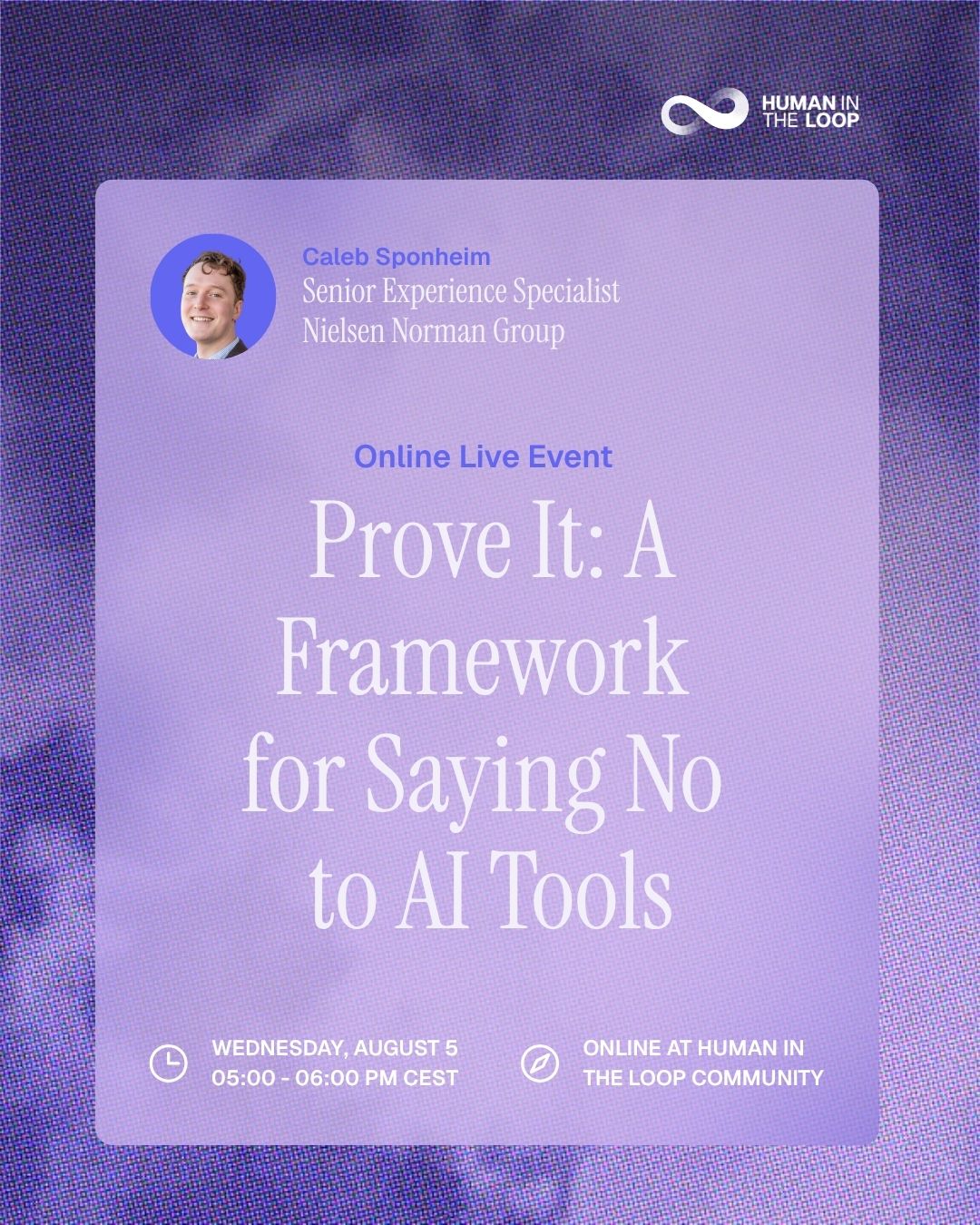
- Event: Prove It: A Framework for Saying No to AI Tools
- Format: Interactive Keynote & Open Discussion
- Location: Exclusively in the Human in the Loop Online Community
- Date & Time: Wednesday, August 5, 05:00-06:00 PM CEST
Ready to optimize your AI toolkit? Join the conversation, challenge the status quo, and connect with fellow product minds shaping the future of digital experiences. Access the Community & Secure Your Spot Here!


.jpg)